Not sure if that old jar of yeast will still raise your dough? Here is how to proof yeast: stir it into warm water with a little sugar, wait ten minutes, and look for a thick, foamy head.
This test is a small step within the wider bread and pastry baking guide.
| Item | Value |
|---|---|
| Test water temperature (dry yeast) | 110-115°F |
| Sugar and water | 1 teaspoon of granulated sugar in 1/2 cup of water |
| Dry yeast amount | One 0.25oz (7g) packet, or 2 1/4 teaspoons |
| Foaming begins | Three to four minutes |
| Pass mark | Foam reaches the 1-cup mark with a rounded top after ten minutes |
These figures come from the Red Star Yeast activity test, and other guides differ a little on temperatures and timings. Figures can change, so check the source before you rely on them.
What proofing tells you before you mix dough
Yeast is a living organism, but the granules in a packet are dried so they stay dormant on the shelf. Warm water wakes them and sugar feeds them, and as they feed they release carbon dioxide, which makes the foam, as Mashed’s March 2021 guide explains.
The date on the pack is not the whole story. Food Republic’s December 2024 guide notes that yeast can lose its viability before its expiration date, while expired yeast can still be active and usable. A short test costs you a spoonful of yeast instead of a flat loaf.
Proofing is also not the same as rising. Proofing only activates the yeast in a small bowl or cup, while rising happens later, once the yeast is mixed into dough with flour and keeps feeding.
How to proof active dry yeast, step by step
This method follows the Red Star Yeast activity test for dry yeast. You need a liquid measuring cup, a spoon, sugar, warm water and your yeast.
- Pour 1/2 cup of warm water, 110-115°F, into a one-cup liquid measuring cup.
- Dissolve 1 teaspoon of granulated sugar in the water.
- Stir in one 0.25oz (7g) packet, or 2 1/4 teaspoons, of dry yeast until no dry granules remain on top.
- Wait. In three to four minutes the yeast should start to foam.
- Check after ten minutes: the foam should have risen to the 1-cup mark and have a rounded top.
No thermometer? Red Star says the tap water should be warm but not hot to the touch. Food Republic warns that water at or near the boiling point will kill your yeast.
Other guides use slightly different numbers. Food Republic’s version uses 1/2 cup of water at 90-110°F with 1/2 teaspoon of sugar, and also waits 10 minutes. Either way, the goal is water that wakes the yeast without cooking it.
Reading the result: pass or fail
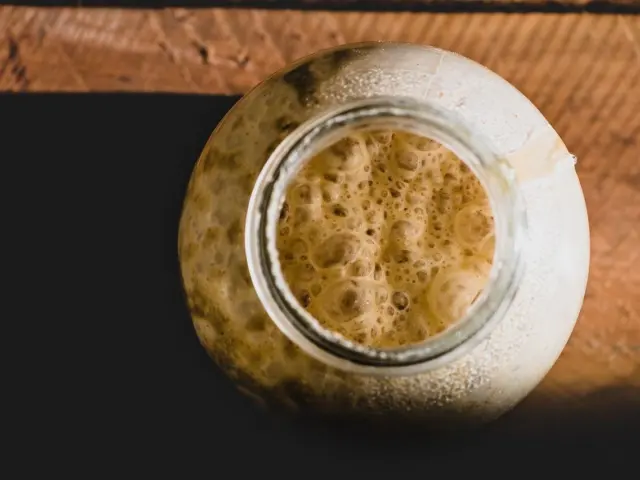
A passing test is easy to spot. After ten minutes the mixture is foamy, domed and at the 1-cup mark, and Red Star says that yeast is very active and should go into your recipe immediately.
- Pass: thick foam, a rounded top and a bready smell. Use it now.
- Weak: a few bubbles, but the foam stops well short of the 1-cup mark. Red Star’s rule is to discard it.
- Fail: flat, cloudy water with no foam. Food Republic says to discard and replace the yeast.
A bready smell is a good sign too, and both Mashed and Food Republic describe it on a healthy test. Smell alone is not enough, so judge the foam first.
When the yeast passes, you can pour the whole mixture into your mixing bowl. Red Star reminds you to deduct 1/2 cup of liquid from the recipe to account for the test water.
Proofing instant and fresh yeast
Instant yeast
Instant yeast was introduced in the 1970s and can go straight into dough with no activation, according to Mashed. If you still want to check an old jar, Food Republic says the same steps work, but the yeast foams faster, within a few minutes rather than 10 minutes.
Instant yeast can look unimpressive in a cup. In a 2009 thread on The Fresh Loaf, a baker reported that instant yeast only clouded the water instead of foaming. A baking911 note quoted in that thread suggests testing a small amount in 1/4 cup of 120°F-130°F water with a tiny amount of sugar.
A flour test is another option, though it is forum advice rather than a lab method. A contributor suggested 1/2 cup of flour, 1/2 tsp of yeast and 1/3 cup of warm water at about 100°F, which should double and turn bubbly in about an hour. The original poster tried it, and both of the jars he had went well beyond double in a bit over an hour (see the thread).
Fresh (cake) yeast
Fresh yeast, also called compressed yeast, is very prone to perishing, says Food Republic. Dissolve 1 teaspoon of sugar in 1/2 cup of water no hotter than 100°F, crumble in the yeast your recipe needs, and after around 10 minutes it should be foamy with a bread-like smell.
Deduct the test water from the recipe as usual, with an exception. If the recipe already asks you to rehydrate the yeast, which is what proofing does, do not subtract the test water.
Why yeast goes bad and what to do next
Food Republic lists exposure to air and moisture, improper storage and aging as the usual causes. Storage matters most: the baking911 note quoted on The Fresh Loaf says yeast stays good well beyond its date if kept frozen, or in a cool, dark place in an unopened package.
- Close the packet or jar tightly after each use to keep air and moisture out.
- Store it cool and dark, or frozen, as the baking911 note suggests.
- Test yeast that has been open for a long time before a big bake.
- Replace it if the test fails, rather than hoping the dough will rise.
If a test fails, check your water before blaming the yeast. Water that was too hot can kill perfectly good yeast, so repeat the test with a thermometer or the warm-not-hot hand check.
Once your yeast passes, you can put it to work in a no knead bread recipe for a simple loaf. If you want a bigger project, read how to make croissants before you start.
Frequently asked questions
Do I need to proof instant yeast?
Show answer
Not usually. Mashed says instant yeast can be mixed straight into the dough without activation, though you can test an old jar using the same steps with a quicker foam.
How long does proofing take?
Show answer
On Red Star’s test, dry yeast starts to foam in three to four minutes and should reach the 1-cup mark after ten minutes. Mashed gives a range of five to ten minutes until the mixture is bubbly.
Can I use yeast that is past its date?
Show answer
Possibly. Food Republic notes that expired yeast can still be active and usable, so test it instead of guessing.
What happens if the water is too hot?
Show answer
It can kill the yeast, so the test will fail even if the yeast was good. Start again with fresh water that feels warm but not hot to the touch.
Do I subtract the proofing water from my recipe?
Show answer
Yes, in most cases. Red Star says to deduct 1/2 cup of liquid, unless the recipe already calls for rehydrating the yeast, as Food Republic notes.