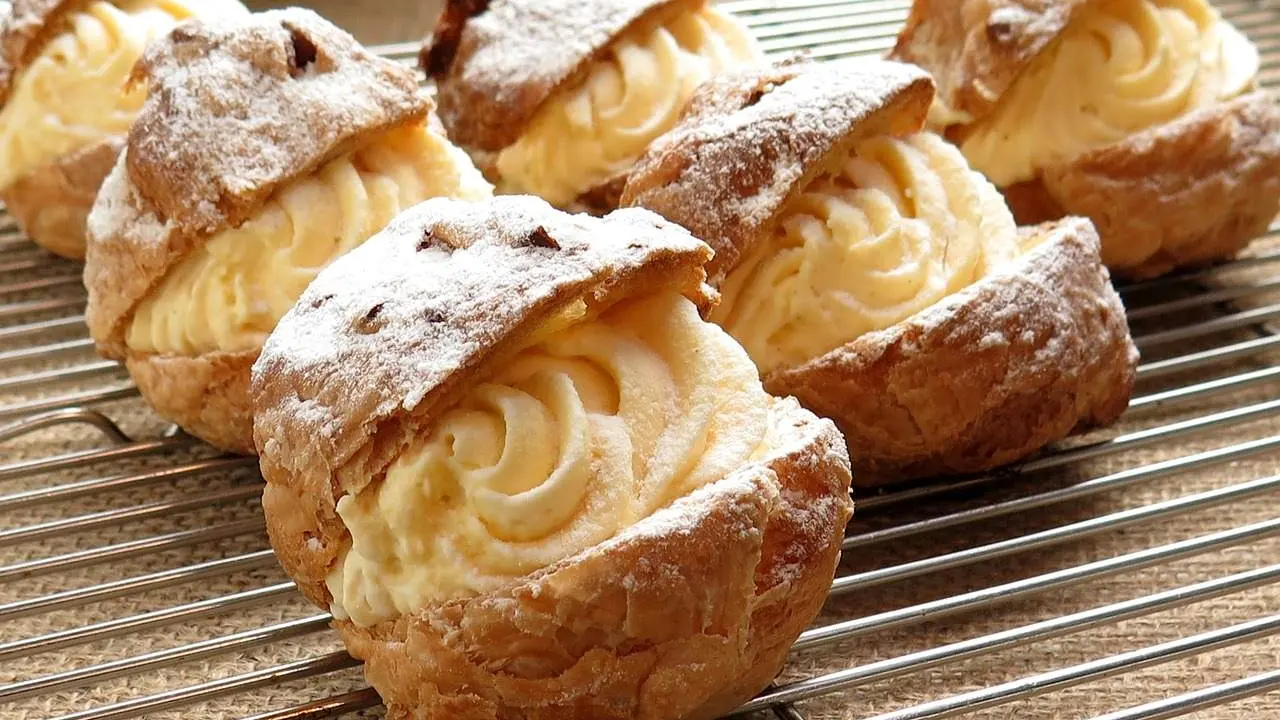
Worried choux will collapse on you? This choux pastry recipe is forgiving: boil the liquid, cook the dough dry, beat in the eggs, then bake until deep golden and dry.
For the bigger picture of doughs and pastries, see the bread and pastry baking guide on this site.
| Item | Value |
|---|---|
| Classic ratio | 2 liquid: 1 butter: 1 flour: 2 egg (by weight) |
| Standard formula | 4 oz milk, 4 oz water, 4 oz butter, 4 oz flour, 8 oz eggs |
| Oven temperature | 375°F (190°C) |
| Bake time | 30-40 minutes, depending on size |
| Oven door stays shut | For the first 25 minutes |
These figures come from Jessica Wang’s Pâte à Choux 101, published Jan 18, 2026. Recipes and ovens vary, so check the source before you rely on the figures.
What makes choux pastry rise?
Choux is a classic French dough used for profiteroles, cream buns, eclairs and Paris-Brest, according to Ayesha Nemat Khan’s guide to choux science. It is known for a crisp outer shell and a hollow centre. The same guide counts seven simple ingredients: milk, water, butter, sugar, salt, flour and eggs.
The dough is cooked twice, once on the stove and once in the oven. It uses no baking powder or soda. It relies on steam from the moisture in the dough to puff up and form its hollow centre.
Flour works differently here than in bread. Usually protein forms gluten, but in choux the starch plays the most important role. That is why you stir this dough rather than knead it. If you want gluten on purpose, read how to knead bread dough.
On the stove, the starch absorbs and traps water, which the guide calls starch gelatinization. In the oven the heat strengthens those bonds until the shell sets at its risen height. Bake the pastry until it is properly set and dried, or it will collapse once the steam escapes.
Choux ingredients and the ratio that scales them
Jessica Wang teaches one ratio to remember: 2 liquid: 1 butter: 1 flour: 2 egg, by weight (source). Because it is a ratio, you can scale a batch up or down and use it to troubleshoot dough that feels off.
Two published formulas show the ratio in practice. Her version is in ounces, and Ayesha Nemat Khan’s is in grams and millilitres (source).
| Ingredient | Jessica Wang’s formula | Ayesha Nemat Khan’s formula |
|---|---|---|
| Liquid | 4 oz milk and 4 oz water | 100 ml full-fat milk and 100 ml water |
| Butter | 4 oz unsalted | 90 grams |
| Flour | 4 oz all-purpose | 100 grams all-purpose |
| Eggs | 8 oz, beaten (about 5 large eggs) | 200 grams |
| Seasoning | A pinch of salt | 2 grams sugar and 2 grams salt |
The ounce figures come from Jessica Wang’s Pâte à Choux 101 and the gram and millilitre figures from Ayesha Nemat Khan’s choux science guide. Check those sources before you rely on the amounts.
Each ingredient has a job, and knowing it helps you adjust:
- Liquid: milk gives richness and color, while water encourages a stronger rise. You can use all milk or all water.
- Butter: it is 80% fat, and too much can give a softer crust that may collapse (source).
- Flour: most recipes use all-purpose. Bread flour has more protein and can give a stronger shell and a better rise.
- Eggs: they add moisture, help emulsify the dough and set to give structure.
- Salt and sugar: both go in only in very small amounts, just to keep the dough from tasting bland.
Choux pastry recipe, step by step
You need very little equipment: a heavy-bottomed pan (ideally not non-stick), a silicone spatula or wooden spoon, a baking tray lined with baking paper, and a piping bag or ziplock bags. A stand mixer helps with the eggs but is not necessary (source).
The method below follows Jessica Wang’s steps.
- Boil the liquid and butter. Combine the milk, water, butter and a pinch of salt in a saucepan. Bring it to a full boil, not a simmer, so the butter melts fully and the liquid is hot enough to gelatinize the flour.
- Add the flour off the heat. Add it all at once and stir immediately until the mixture absorbs the liquid and forms a cohesive dough.
- Cook the panade. Return the pan to medium heat and stir constantly until a thin film forms on the bottom of the pot. Under-cooked dough leads to flat or dense choux.
- Cool before the eggs. Mix in a stand mixer with the paddle on low speed until the bowl is just barely warm to the touch. Dough that is too hot will scramble the eggs.
- Add the eggs gradually. Add the beaten eggs one quarter at a time, fully mixing in each addition. Slow down on the last addition, because you may not need all the egg.
Piping and baking for a dry, golden shell
Pipe rounds for cream puffs, logs for eclairs or rings for Paris-Brest. Baking on a perforated silicone mat gives even heat circulation, and a topping of craquelin adds texture and a professional finish (source).
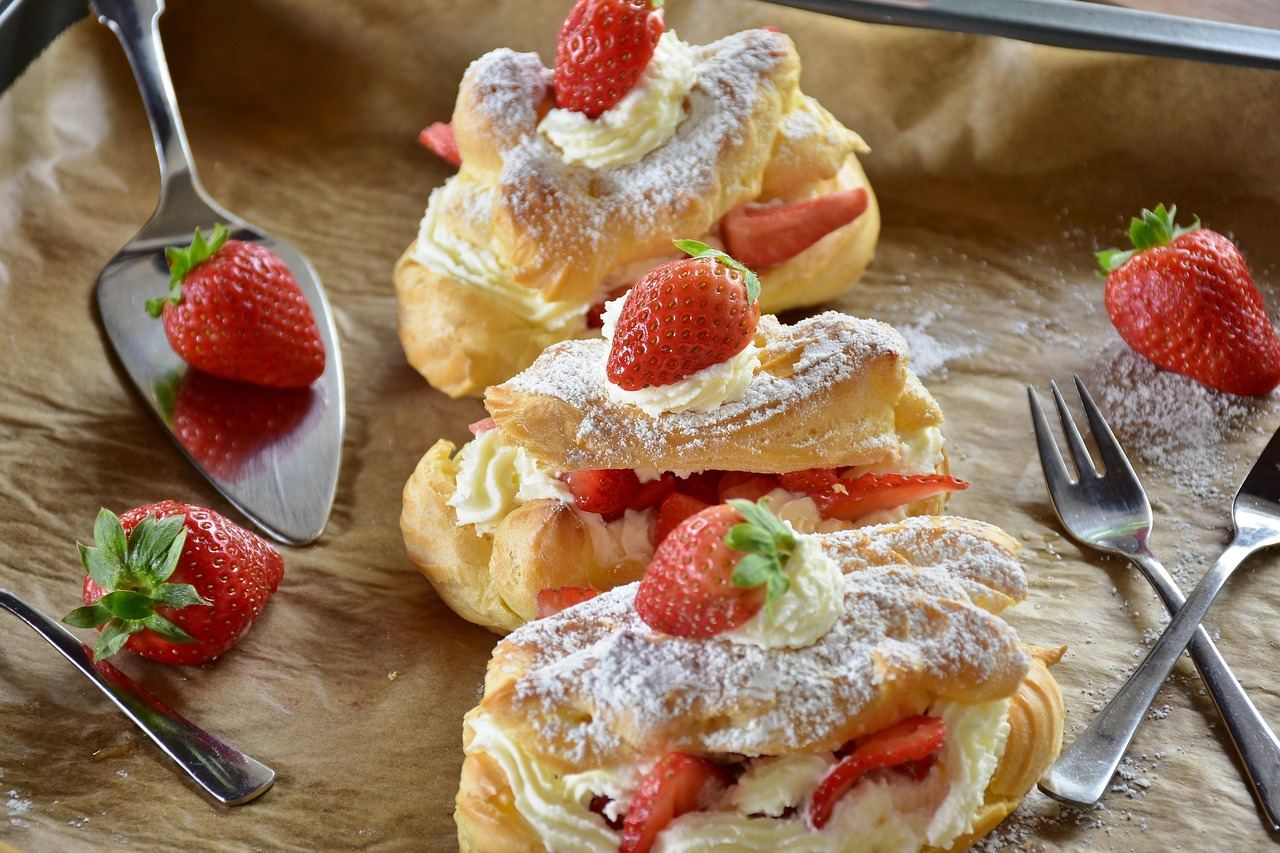
Bake in a fully preheated 375°F (190°C) oven for 30-40 minutes, depending on size (source). Keep these rules in mind:
- Do not open the oven door during the first 25 minutes, because choux relies on steam to rise.
- Look for a deep golden brown, not pale shells.
- Judge by dryness, not just color. Choux is finished when it is dry.
If you pull the puffs too early, they will collapse as they cool.
How to tell the dough and the shells are right
Judge the dough by how it moves, not by the clock. It is ready when it falls from the spatula in a smooth V shape, or when a finger dipped in the dough leaves a soft, relaxed peak. Too stiff and it will not rise, and too loose and it will not hold its shape (source).
Well-baked shells share three signs:
- They are deeply golden.
- They feel light for their size.
- They are hollow inside with minimal webbing.
Once the shells come out right, you may want a harder challenge, such as how to make croissants.
Filling and finishing
Jessica Wang often fills choux with diplomat cream, which is pastry cream lightened with whipped cream. Cut a small X in the bottom of each puff, insert the piping tip and fill until the cream just begins to peek out (source).
Finish with a glaze, fondant or simply powdered sugar. The shell can also take savory fillings, because the pastry itself has a neutral flavor (source).
Frequently asked questions
Do I need baking powder in choux pastry?
Show answer
No. Choux uses no leavening agent and relies on steam from the moisture in the dough to rise.
Why did my choux puffs collapse?
Show answer
The usual cause is shells that were not baked until dry, since pulling them too early makes them collapse as they cool. Dough that was under-cooked on the stove can also turn out flat or dense, and too much butter can soften the crust.
Can I use only milk or only water?
Show answer
Yes. The half-and-half version is the traditional balance: milk adds richness and color, and water encourages a stronger rise.
Can I use bread flour instead of all-purpose?
Show answer
Some recipes do. Its higher protein content can give a stronger shell and a better rise, though all-purpose is the typical choice.